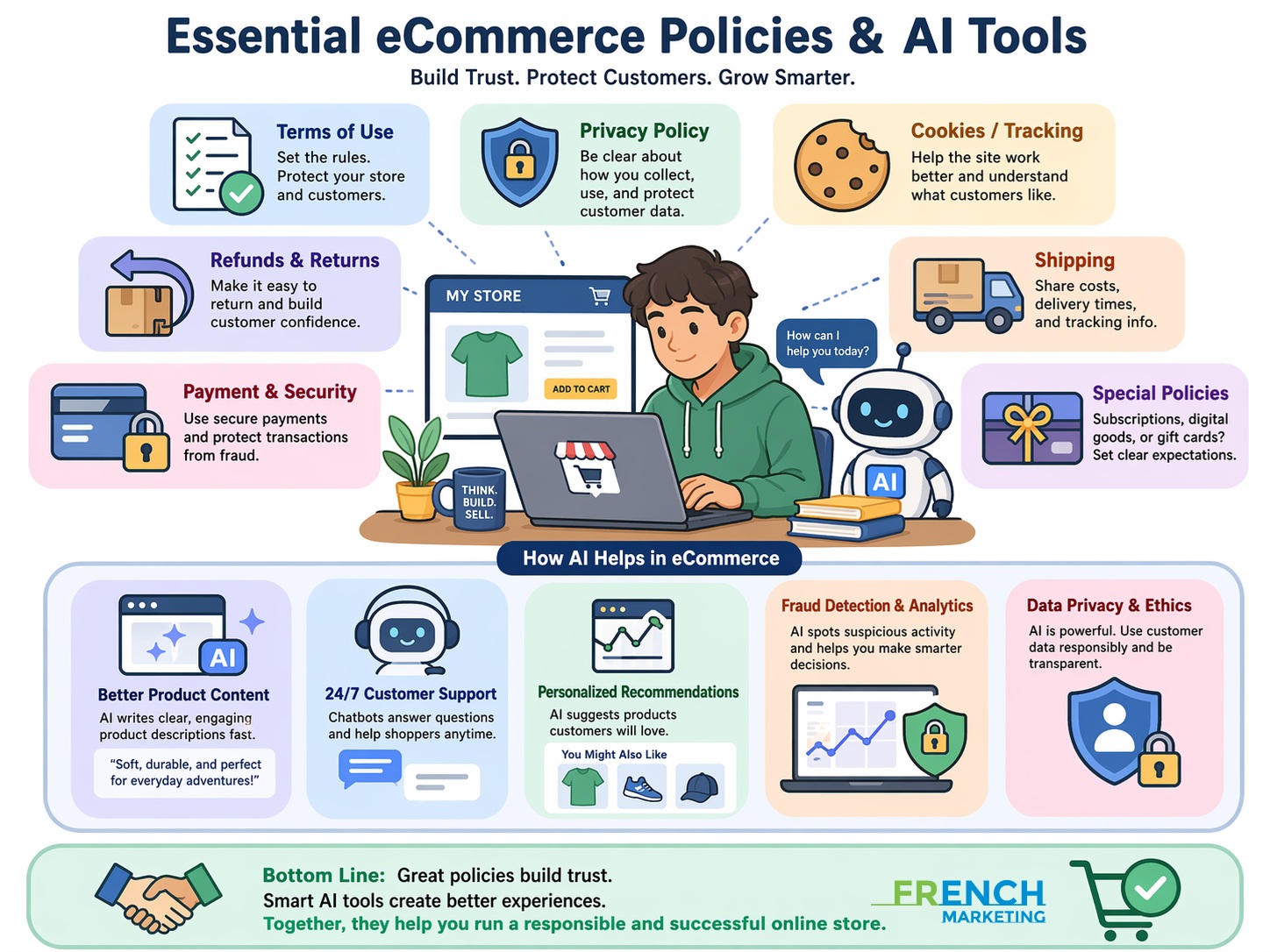
A Student Guide to the Essential Policies Every Online Store Should Have
Many people are excited to launch an online store because eCommerce tools make selling easier than ever. Today, students can build a store quickly using platforms, templates, AI writing assistants, chatbots, ad tools, and automated customer service systems. But a store is not truly ready just because it looks professional.
A serious eCommerce business needs clear policies.
These policies do more than protect the company. They help customers understand what to expect, reduce confusion, improve trust, and show that the business is operating responsibly. Shopify explicitly requires merchants to provide public-facing contact information, terms of service, a refund policy, and shipping policies, including order-fulfillment timelines. Shopify also states that this public-facing contact information should include the merchant’s name, address, telephone number, and email address. If a merchant uses a third-party supplier, customers should be informed.
Today, this matters even more because AI tools can make an online store seem more polished than it really is. A store may have AI-generated product descriptions, automated customer support, personalized recommendations, or dynamic marketing content. These tools can improve efficiency, but they also create new responsibilities. Students need to understand that AI does not remove the need for human judgment. If anything, it increases the need for clear rules, honest communication, and responsible handling of customer data.
Below are the most important policy areas an eCommerce business should plan before launching.
1. Terms of Use
The Terms of Use explain the general rules for using the website. They tell users what is allowed, what is not allowed, and what legal conditions apply when someone visits the store or creates an account.
A minimum Terms of Use section should usually include:
- rules for users of the site
- account suspension or termination rights
- how a customer can close an account
- disclaimers or exclusions of warranty
- limits of liability
- the law that governs disputes
- business contact information
For students, the main idea is simple: the Terms of Use define the relationship between the business and the user. They are part legal protection, part expectation-setting. A weak or missing Terms of Use page can make a store look unprofessional and may leave important questions unanswered.
AI has made this area more complicated. Some businesses now use AI chatbots, AI-generated answers, or AI-assisted recommendation systems. If an AI tool gives incorrect information, the customer may still hold the business responsible. That means businesses should not rely on AI-generated wording without reviewing it carefully. The store owner remains accountable for what appears on the site.
2. Privacy Policy
The Privacy Policy explains what personal information the business collects, why it collects it, how it stores it, how it protects it, and whether it shares it with third parties.
A minimum Privacy Policy should explain how the business uses and protects data such as:
- names
- addresses
- phone numbers
- email and contact information
- payment-related information
- browsing and tracking information
- cookies and advertising pixels
- analytics data
This is no longer optional or minor. In Québec, the Act respecting the protection of personal information in the private sector requires any person carrying on an enterprise to establish and implement governance policies and practices regarding personal information. These policies and practices must ensure the protection of personal information. The law also requires organizations to collect personal information only for serious and legitimate reasons and to inform the person of the purposes for which the information is collected. Sensitive information generally requires express consent.
For students, this means that privacy is not just a legal formality. It is a business issue and a trust issue. Customers want to know:
- What data are you collecting?
- Why are you collecting it?
- How long will you keep it?
- Who else will see it?
- How can they request access, correction, or deletion?
AI tools raise the stakes here. Many businesses now use AI for recommendation engines, fraud detection, automated customer service, personalized email campaigns, and analytics. Those systems often rely on customer data. If students use AI tools in an eCommerce business, they should ask:
- Is customer data being sent to a third-party AI tool?
- Is that tool storing prompts or outputs?
- Is it using data for model training?
- Has the customer been informed appropriately?
Those are not abstract questions. They affect compliance, ethics, and customer trust.
3. Cookies, Tracking, and Advertising Transparency
In older eCommerce guides, cookies were often treated as a small technical detail. Today, they deserve direct attention.
Many online stores use cookies, pixels, session trackers, analytics tools, heatmaps, retargeting scripts, and advertising technologies. These tools help businesses understand behavior, improve marketing, and personalize content. But they also involve tracking.
The Office of the Privacy Commissioner of Canada states that knowledge and consent are required for the collection, use, or disclosure of personal information, and that the purposes must be explained in a clear and transparent way. The Office also notes concerns about online behavioural advertising, especially when users do not clearly understand how tracking works or what choices they have.
A student-friendly policy on cookies and tracking should explain:
- what kinds of tracking tools the store uses
- why they are used
- whether they are necessary, analytical, or advertising-related
- whether third parties place cookies on the site
- what choices the user has
This area is especially important when AI is involved. AI-driven marketing tools may use browsing behavior to segment customers, predict interests, or automate personalized offers. That can improve performance, but it can also feel intrusive if it is not handled transparently.
4. Refund and Return Policy
A Refund and Return Policy explains what happens after a customer buys a product and wants to return it, exchange it, or ask for money back.
At a minimum, this policy should explain:
- how many days the customer has to request a return
- whether partial refunds are possible
- what condition the item must be in
- whether proof of purchase is required
- whether exchanges or replacements are offered
- how the item must be sent back
- which shipping costs are paid by the business and which are paid by the customer
This is one of the most important trust-building pages on any online store. Customers often decide whether to buy based on how safe the purchase feels. A vague return policy increases hesitation.
Shopify’s help materials also make clear distinctions among refunds, returns, and exchanges. Merchants can set return rules, control eligible items, and define return timeframes.
AI can affect this area too. For example, AI may be used to auto-approve certain requests, classify return reasons, or predict fraud. That may help operations, but students should remember that automation can make mistakes. A refund policy should not become unfair just because software is making the first decision. Human review still matters.
5. Shipping Policy
A Shipping Policy explains how products get from the seller to the buyer.
A minimum shipping policy should include:
- standard shipping costs
- extra charges for non-standard shipping
- estimated order processing times
- estimated delivery times
- where the business ships and does not ship
- customs and duties if relevant
- insurance if relevant
- package tracking methods
- what happens if an order is delayed, lost, or not received
This policy is important because many customer complaints in eCommerce are not about the product itself. They are about timing, uncertainty, and expectations. Customers want clarity. Shopify specifically requires shipping policies, including fulfilment timelines, to be public-facing.
AI can help estimate delivery windows, identify shipping risks, and automate status messaging. That is useful, but students should not confuse prediction with certainty. If AI estimates are shown to customers, the business should be careful not to present guesses as guarantees.
6. Payment, Fraud, and Security Policy
This area is often forgotten in beginner eCommerce documents, but it is increasingly important.
A good online store should explain:
- which payment methods it accepts
- when payment is captured
- how suspicious transactions may be reviewed
- when an order may be cancelled for fraud concerns
- what happens in the case of chargebacks or payment disputes
This matters because customers want secure transactions, and businesses need protection against fraud. Shopify’s payment and chargeback materials show that merchants need to handle disputes, payment reversals, and fraud-related issues carefully.
AI is now commonly used for fraud screening and risk scoring. That can help prevent losses, but students should understand the tradeoff. Automated systems can misclassify legitimate customers. A business should not assume that an AI decision is automatically fair or correct.
7. Special Policies Depending on the Business Model
Not every eCommerce business is the same. Some stores need extra policies.
For example:
- a subscription business may need a subscription cancellation policy
- a digital goods business may need a no-return or limited-return policy
- a preorder business may need a policy explaining delayed fulfillment
- a gift card business may need separate terms
- an international business may need customs and duties explanations
Shopify notes that if a merchant sets up subscriptions, a subscription cancellation policy is automatically added and linked in key parts of the shopping and checkout experience.
Students should learn an important lesson here: policies should match the actual business model. Copying a generic policy template without adapting it can create confusion or even mislead customers.
What AI Changes in eCommerce Policy Writing
AI tools can help students draft policies faster, summarize legal wording, create customer service scripts, and generate FAQ content. That is useful. But AI also introduces risk.
Students should remember five things:
First, AI-generated policies may sound convincing while still being incomplete, outdated, or inaccurate. The store owner is still responsible.
Second, AI tools often depend on data. If customer information is entered into outside systems without proper review, privacy and compliance risks increase.
Third, AI personalization can improve customer experience, but it can also create ethical concerns if it becomes too intrusive or opaque.
Fourth, AI chatbots can answer questions quickly, but they may also make promises the business never intended to make.
Fifth, automation should support decision-making, not replace accountability.
In other words, AI can help write, analyze, predict, and respond. But it does not remove the need for business judgment.
Final Advice for Students
If you are building an online store, do not treat policies as a last-minute legal page hidden in the footer. They are part of the customer experience.
A strong eCommerce store does not just say, “Buy from us.” It also says:
- Here is how we handle your data.
- Here is how returns work.
- Here is how shipping works.
- Here is how to contact us.
- Here is what happens if something goes wrong.
That level of clarity builds trust.
And in the age of AI, trust matters even more, because customers may not always know when content, support, pricing, or recommendations are being shaped by automated systems. The more technology a business uses, the more important transparency becomes.
APA References
Office of the Privacy Commissioner of Canada. (2011, October 13). Online behavioural advertising in brief. https://www.priv.gc.ca/en/privacy-topics/technology/online-privacy-tracking-cookies/tracking-and-ads/02_05_d_52_ba_02/
Office of the Privacy Commissioner of Canada. (2025, August 11). Guidelines on privacy and online behavioural advertising. https://www.priv.gc.ca/en/privacy-topics/technology/online-privacy-tracking-cookies/tracking-and-ads/gl_ba_1112/
Office of the Privacy Commissioner of Canada. (2025, August 11). Policy position on online behavioural advertising. https://www.priv.gc.ca/en/privacy-topics/technology/online-privacy-tracking-cookies/tracking-and-ads/bg_ba_1206/
Québec. Act respecting the protection of personal information in the private sector, CQLR c P-39.1. https://www.legisquebec.gouv.qc.ca/en/document/cs/p-39.1
Shopify. (2025, October 21). Terms of service. https://www.shopify.com/legal/terms
Shopify. (2026, March 2). Privacy policy. https://www.shopify.com/legal/privacy
Shopify Help Center. (n.d.). Returns and exchanges. https://help.shopify.com/en/manual/fulfillment/managing-orders/returns
Shopify Help Center. (n.d.). Canceling orders. https://help.shopify.com/en/manual/fulfillment/managing-orders/canceling-orders
Shopify Help Center. (n.d.). Chargebacks and inquiries. https://help.shopify.com/en/manual/payments/chargebacks
Shopify Help Center. (n.d.). Setting up Shopify Subscriptions. https://help.shopify.com/en/manual/products/purchase-options/subscriptions/shopify-subscriptions/setup