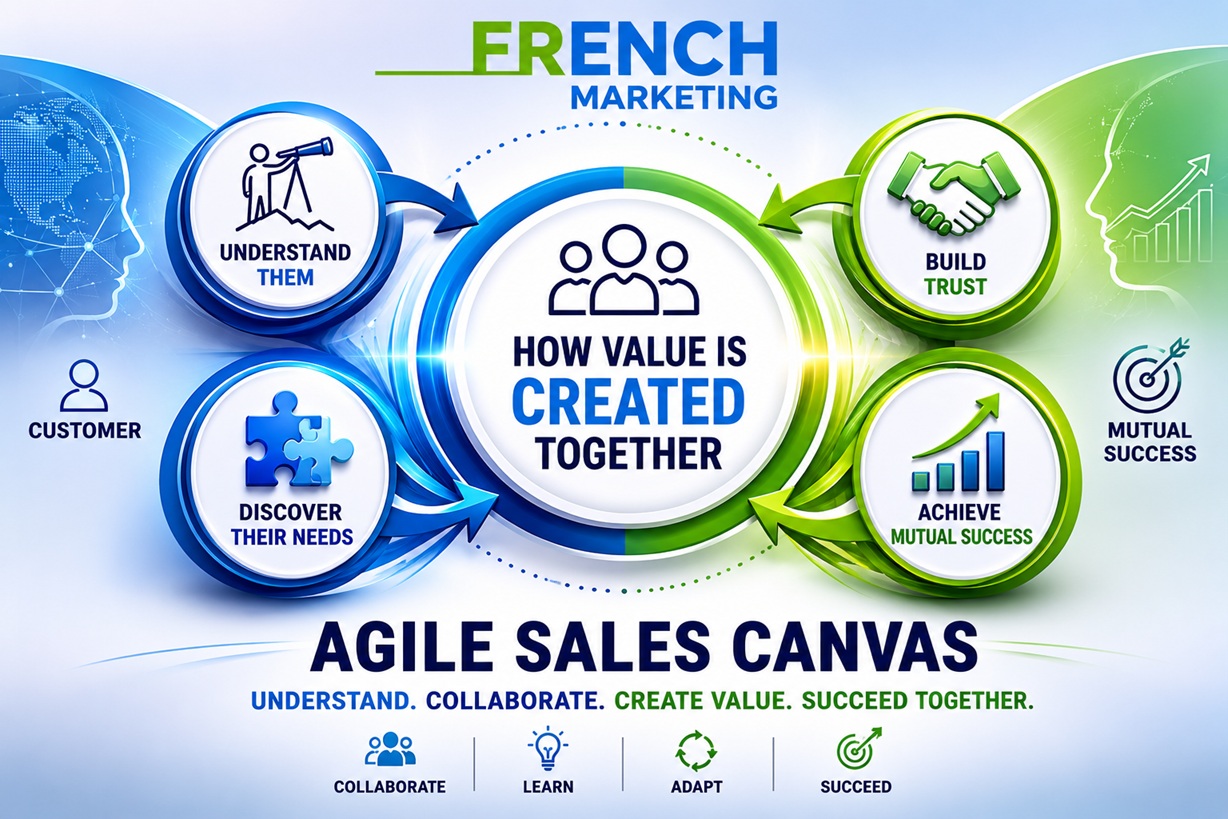
A Collaborative Adaptive Value-Creation System for Agile Sales
Collaborate. Learn. Adapt. Create Value Together.
Introduction
The Agile Sales Canvas is not simply a sales planning tool. It is a collaborative adaptive value-creation system designed to help organizations better understand customers, build trust, create value collaboratively, and continuously improve through learning, feedback, and adaptation.
Unlike traditional sales approaches that often emphasize persuasion, rigid pipelines, scripted interactions, or transactional closing techniques, the Agile Sales Canvas reframes sales as:
- collaborative,
- iterative,
- customer-centered,
- adaptive,
- relationship-driven,
- and focused on sustainable value creation.
At its core, the Agile Sales Canvas reflects a fundamental shift in how organizations think about sales.
Traditional models often treat sales as a sequence of activities designed primarily to move prospects toward a transaction. The Agile Sales Canvas approaches sales differently. It views sales as a living system of interaction, learning, adaptation, and collaborative value creation.
Rather than asking:
“How do we sell this?”
The framework encourages organizations to ask:
“How do we create meaningful value together?”
The Agile Sales Canvas recognizes that modern customers are more informed, more connected, and often more skeptical of purely transactional sales approaches. In many industries, long-term trust, collaboration, adaptability, and customer understanding are now more important than rigid scripts or aggressive closing tactics.
The framework therefore helps organizations move toward a more sustainable sales philosophy built on:
- understanding,
- listening,
- collaboration,
- adaptability,
- transparency,
- and mutual success.
Core Innovation: The Foldable Overlay Structure
One of the most distinctive and innovative aspects of the Agile Sales Canvas is its foldable and overlaying structure.
When the canvas is folded in the middle, sections on one side align with complementary sections on the opposite side.
This overlay logic reveals how different dimensions of agile sales reinforce one another.
The canvas demonstrates that:
- customer understanding shapes value creation,
- trust strengthens collaboration,
- learning improves adaptation,
- transparency supports accountability,
- and operational behavior directly influences customer success.
This structure transforms the canvas from a static visual model into an interconnected adaptive system.
The foldable relationships show that agile sales is not composed of isolated activities. Instead, every section continuously influences and strengthens another.
The framework therefore encourages organizations to stop viewing sales activities independently.
For example:
- listening influences customer understanding,
- customer understanding improves value creation,
- transparency strengthens trust,
- trust improves collaboration,
- collaboration improves learning,
- and learning improves adaptability.
This interconnectedness is one of the defining characteristics of the Agile Sales Canvas.
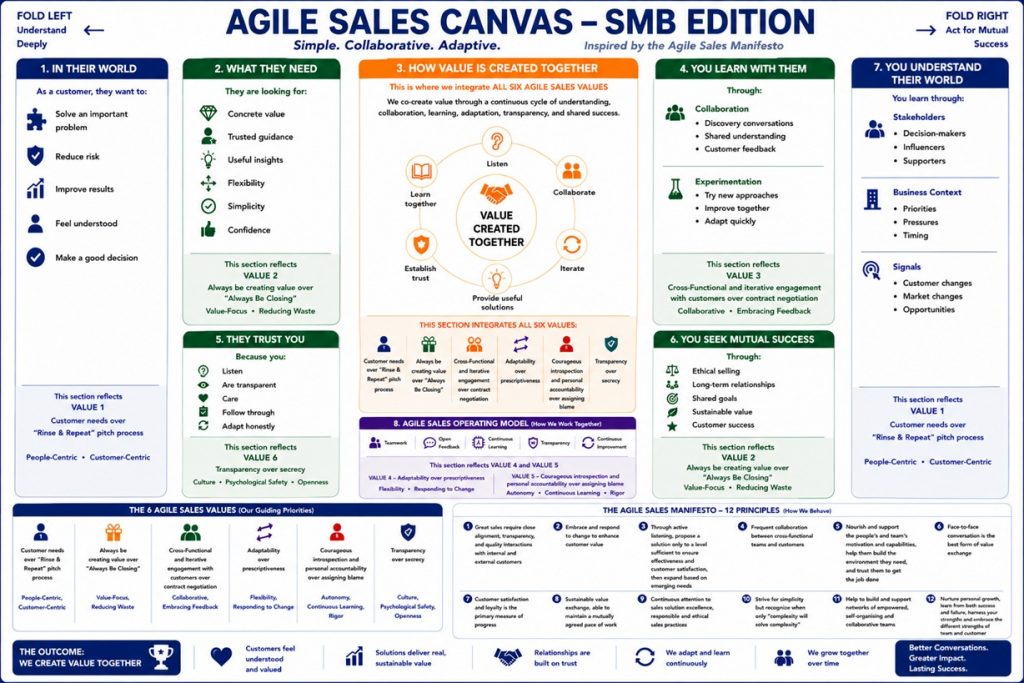
The Centre of the Canvas
“How Value Is Created Together”
At the center of the Agile Sales Canvas is the core principle that connects every section:
“How Value Is Created Together”
This center represents the convergence of all six Agile Sales Manifesto values.
Unlike many traditional sales models that position value as something delivered by the organization to the customer, the Agile Sales Canvas views value as something created collaboratively.
This distinction is foundational.
The framework recognizes that:
- customers contribute knowledge,
- organizations contribute expertise,
- collaboration improves understanding,
- iteration improves outcomes,
- and mutual learning strengthens long-term success.
The center therefore represents:
- collaborative value creation,
- adaptive learning,
- trust development,
- customer-centered problem solving,
- and continuous refinement.
Everything within the canvas ultimately converges toward this collaborative process.
Understanding the Structure of the Agile Sales Canvas
The Agile Sales Canvas is organized into:
- three primary layers,
- two operational levels,
- foldable relationships,
- and interconnected value-creation dynamics.
The framework progressively moves:
- from customer understanding,
- to relationship development,
- to collaborative value creation,
- and finally toward continuous adaptation and operational improvement.
This structure ensures that sales activities remain:
- customer-centered,
- iterative,
- adaptive,
- collaborative,
- transparent,
- and value-driven.
Rather than functioning as a rigid linear process, the canvas behaves as a living adaptive system.
Outer Layer
Customer Understanding & Environmental Awareness
The outer layer focuses on understanding the customer’s reality and the environment influencing customer decisions.
This layer encourages organizations to move beyond assumptions and develop a more holistic understanding of:
- customer motivations,
- pressures,
- constraints,
- business realities,
- and changing environments.
1. “In Their World”
This section represents the starting point of the canvas.
Organizations begin by understanding the customer’s reality rather than beginning with:
- predefined scripts,
- generic pitches,
- or internal assumptions.
The objective is to understand:
- the customer’s goals,
- challenges,
- pressures,
- frustrations,
- constraints,
- and desired outcomes.
Organizations ask:
- What problems are customers trying to solve?
- What risks are they trying to reduce?
- What pressures are influencing their decisions?
- What outcomes are they trying to achieve?
- What would make them feel genuinely understood?
This section reflects:
Value #1
Customer needs over “Rinse & Repeat” pitch process
This section encourages:
- empathy,
- curiosity,
- active listening,
- and customer-centered discovery.
The framework therefore shifts organizations away from repetitive sales behavior and toward meaningful customer understanding.
7. “You Understand Their Environment”
This section complements “In Their World” by expanding customer understanding into broader contextual awareness.
Organizations gather insights about:
- stakeholders,
- organizational priorities,
- business constraints,
- timing,
- market conditions,
- operational realities,
- opportunities,
- and environmental changes.
This section reinforces an important idea:
Empathy alone is not enough.
Organizations must also understand the broader context influencing customer decisions.
This section also reflects:
Value #1
Customer needs over “Rinse & Repeat” pitch process
Together, Sections 1 and 7 create a foldable relationship between:
- empathy,
- and contextual intelligence.
One side asks:
“What is the customer experiencing?”
The other asks:
“What environment is shaping that experience?”
This overlay relationship helps organizations develop a deeper and more realistic understanding of customer situations.
Middle Layer
Value Creation & Relationship Development
The middle layer focuses on:
- identifying meaningful value,
- building trust,
- collaborative learning,
- and creating sustainable customer relationships.
2. “What They Need”
Once organizations understand the customer’s environment, they can begin identifying the practical value customers are truly seeking.
This section focuses on:
- meaningful outcomes,
- useful guidance,
- relevant solutions,
- flexibility,
- simplicity,
- confidence,
- and practical support.
Rather than pushing predefined products or services, organizations focus on solving meaningful customer problems.
This section reflects:
Value #2
Always be creating value over “Always Be Closing”
The focus therefore shifts:
- away from transactional pressure,
- and toward sustainable value creation.
6. “You Seek Mutual Success”
This section reinforces that successful sales relationships should create sustainable value for both the customer and the organization.
Organizations focus on:
- ethical selling,
- long-term relationships,
- shared goals,
- customer success,
- sustainable growth,
- and durable value exchange.
Sales success is therefore measured not only by transactions, but also by:
- relationship quality,
- customer satisfaction,
- trust,
- and long-term outcomes.
This section also reflects:
Value #2
Always be creating value over “Always Be Closing”
Together, Sections 2 and 6 create a foldable relationship between:
- customer needs,
- and mutual value creation.
The relationship reinforces that customer value and organizational success should strengthen one another rather than compete against one another.
5. “They Trust You”
Trust is one of the foundational pillars of agile sales.
This section emphasizes that trust is earned through:
- transparency,
- consistency,
- accountability,
- honesty,
- reliability,
- ethical behavior,
- listening,
- and psychological safety.
Customers trust organizations when they feel:
- understood,
- respected,
- supported,
- and treated fairly.
This section reflects:
Value #6
Transparency over secrecy
The framework therefore recognizes that:
trust is not simply a communication tactic.
It is a long-term operational behavior.
Without trust:
- collaboration weakens,
- feedback decreases,
- customer openness declines,
- and long-term value creation becomes difficult.
4. “You Learn With Them”
This section emphasizes that sales is an iterative learning process rather than a rigid linear process.
Organizations continuously:
- engage with customers,
- gather feedback,
- validate assumptions,
- experiment,
- adapt,
- and improve collaboratively.
Customer understanding evolves through interaction rather than static assumptions.
This section reflects:
Value #3
Cross-Functional and iterative engagement with customers over contract negotiation
The section reinforces:
- collaboration,
- experimentation,
- learning,
- iteration,
- and feedback-driven improvement.
The framework recognizes that:
great sales environments are not built around static scripts.
They are built around adaptive learning systems.
Inner Layer
Collaborative Value Creation
3. “How Value Is Created Together”
This is the collaborative core and convergence point of the entire Agile Sales Canvas.
Unlike the other sections, this center section is not limited to a single manifesto value because it integrates all six Agile Sales Manifesto values simultaneously.
The center represents:
- customer-centricity,
- value creation,
- collaboration,
- adaptability,
- introspection,
- accountability,
- transparency,
- and continuous learning.
It reflects how organizations and customers:
- listen together,
- learn together,
- adapt together,
- establish trust together,
- and continuously refine value together.
This section operationalizes the idea that:
value is not simply delivered to customers — it is created collaboratively with them.
Everything within the canvas ultimately converges toward this collaborative value-creation process.
The center therefore represents:
- the collaborative engine of the framework,
- the convergence point of the manifesto,
- and the living operational core of agile sales.
Operational Layer
“Agile Sales Operating Model”
This section represents the adaptive operational engine of the Agile Sales Canvas.
It focuses on how organizations support agile sales through:
- teamwork,
- transparency,
- adaptability,
- accountability,
- responsible AI support,
- continuous learning,
- open communication,
- and continuous improvement.
This section combines:
Value #4
Adaptability over prescriptiveness
AND
Value #5
Courageous introspection and personal accountability over assigning blame
Together, these values encourage organizations to:
- remain flexible,
- continuously learn,
- respond constructively to feedback,
- improve collaboratively,
- and adapt effectively to change.
This operating model supports the organizational behaviors and cultural environment necessary for agile sales to function successfully.
The framework therefore emphasizes that agile sales is not only about external customer interactions.
It is also about:
- internal alignment,
- operational transparency,
- communication quality,
- adaptability,
- and organizational learning.
Bottom Level
“We Create Value Together”
The bottom level represents the outcomes generated by the Agile Sales Canvas.
Organizations create environments where:
- customers feel understood,
- trust is strengthened,
- value is continuously refined,
- relationships become more collaborative,
- learning improves future interactions,
- and mutual success becomes sustainable.
The outcome is not simply:
- closing deals,
- increasing activity,
- or maximizing transactions.
Instead, the outcome becomes the creation of:
- meaningful relationships,
- adaptive collaboration,
- sustainable value,
- customer trust,
- and long-term customer success.
Power of Foldable Interdependencies in Canvas
One of the most innovative aspects of the Agile Sales Canvas is its foldable structure.
When the canvas is folded down the middle, complementary sections align with one another.
These foldable relationships reveal how different dimensions of agile sales reinforce each other.
The framework therefore demonstrates that agile sales is not composed of isolated activities but functions as an interconnected adaptive value-creation system.
Foldable Interdependencies
“In Their World” ↔ “You Understand Their Environment”
Empathy must be supported by contextual understanding.
Organizations combine:
- customer empathy,
- stakeholder awareness,
- market insights,
- and organizational realities
in order to develop a holistic understanding of customer situations.
This relationship helps organizations move beyond assumptions and simplistic sales narratives.
“What They Need” ↔ “You Seek Mutual Success”
Customer needs create sustainable relationships when they lead to mutual value creation.
This relationship reinforces:
- ethical selling,
- customer success,
- long-term collaboration,
- and shared outcomes.
The overlay demonstrates that:
customer value and organizational value should reinforce one another.
“You Learn With Them” ↔ “How Value Is Created Together”
Learning, experimentation, and feedback continuously refine collaborative value creation.
This relationship reinforces that agile sales evolves through:
- interaction,
- iteration,
- adaptation,
- and shared learning.
The more organizations learn with customers, the more effectively they can refine value creation.
“They Trust You” ↔ “Agile Sales Operating Model”
Trust emerges directly from organizational behavior.
Transparency, accountability, adaptability, and responsible operational practices shape:
- customer trust,
- relationship quality,
- and long-term collaboration.
This relationship demonstrates that trust is not accidental.
It is the result of operational consistency, ethical behavior, transparency, and organizational alignment.
All Paths Lead to the Centre
“How Value Is Created Together”
Every section of the Agile Sales Canvas ultimately converges toward collaborative value creation.
Customer understanding, trust, adaptability, learning, transparency, accountability, and mutual success all contribute toward building meaningful and sustainable value together.
The center therefore represents:
- the convergence point of the framework,
- the collaborative engine of agile sales,
- and the operational manifestation of the Agile Sales Manifesto itself.
The Real Innovation of the Agile Sales Canvas
Traditional sales models often separate:
- prospecting,
- relationship management,
- customer success,
- operational learning,
- value creation,
- and adaptation
into disconnected activities.
The Agile Sales Canvas integrates all of these dimensions into a single collaborative adaptive value-creation system.
Rather than encouraging:
- rigid scripts,
- isolated sales behavior,
- transactional pressure,
- or static processes,
The framework encourages organizations to:
- collaborate,
- learn,
- adapt,
- build trust,
- continuously improve,
- and create value together with customers.
The framework therefore transforms sales from:
- a transactional process,
into:
- a dynamic,
- iterative,
- customer-centered,
- relationship-driven discipline focused on sustainable value creation.
Integrating the Agile Sales Manifesto into the Agile Sales Canvas
The Agile Sales Canvas operationalizes the values and principles of the Agile Sales Manifesto through every section of the framework.
Rather than treating manifesto values as abstract concepts, the canvas embeds them directly into:
- customer interactions,
- operational behavior,
- learning systems,
- collaborative practices,
- trust-building processes,
- and value-creation activities.
Each section reflects specific manifesto values while the center integrates all six values simultaneously.
The framework therefore becomes more than a visual model.
It becomes:
- a collaborative adaptive value-creation system,
- a practical operating philosophy,
- and a living manifestation of agile sales principles in action.
The Agile Sales Canvas as a Collaborative Adaptive Value-Creation System
The Agile Sales Canvas redefines sales as a collaborative, adaptive, customer-centered discipline focused on creating sustainable value together with customers.
Its foldable structure, interconnected relationships, manifesto alignment, and collaborative core help organizations move beyond:
- scripted selling,
- transactional thinking,
- isolated sales activities,
- and rigid operational behavior.
Instead, organizations develop environments centered on:
- trust,
- learning,
- adaptability,
- transparency,
- collaboration,
- accountability,
- and long-term customer success.
The Agile Sales Canvas therefore provides organizations with:
- a practical operating philosophy,
- a customer-centered adaptive system,
- and a modern approach to building meaningful, sustainable, and value-driven sales environments in a rapidly evolving world.
In this sense, the framework is not simply about improving sales performance.
It is about transforming the relationship between organizations and customers into a more collaborative, adaptive, ethical, and value-centered partnership.
The Agile Sales Canvas therefore positions sales not merely as a transactional function, but as a continuous collaborative process of learning, trust-building, adaptation, and sustainable value creation.